Monday, May 27, 2013

Why Be The Best, Really?

The best team wins the World Series, duh.

Or, perhaps, the team that wins the World Series is crowned "the best," but is not necessarily actually the best.

There, that makes more sense.

First of all, let me reference a book about randomness by Leonard Mlodinow. He states that

...if one team is good enough to warrant beating another in 55% of its games, the weaker team will nevertheless win a 7-game series about 4 times out of 10.  And if the superior team could beat its opponent, on average, 2 out of 3 times they meet, the inferior team will still win a 7-game series about once every 5 match-ups.  There is really no way for a sports league to change this.  In the lopsided 2/3-probability case, for example, you’d have to play a series consisting of at minimum the best of 23 games to determine the winner with what is called statistical significance, meaning the weaker team would be crowned champion 5 percent or less of the time.  And in the case of one team’s having only a 55-45 edge, the shortest significant “world series” would be the best of 269 games, a tedious endeavor indeed! So sports playoff series can be fun and exciting, but being crowned “world champion” is not a reliable indication that a team is actually the best one. (p. 70-71)

So, according to Mlodinow, a 7-game series is not a large enough sample size to determine which team is actually the best; it leaves too much room to random chance.

Now, all this follows from my last post regarding losing on purpose in order to build for the future. There really is no point, except in very rare cases (see 2013 Houston Atros), in punting a season, since even being able to guarantee success through spending big probably wouldn't be enough to win the World Series.

Let's see how the "best team" has fared in the playoffs in the past, from 1969 (the year after more than two teams appeared in the post season) to the present, spanning 43 years:


  1. The team with the highest winning percentage (simply, the team that wins the most during the 162-regular season) has won the World Series 10 times
  2. The team with the highest Pythagorean Win-Loss (expected win-loss record based on runs scored and allowed by a team) has won 11 times
So, in the past, almost three quarters of the time the "best team" has failed to win the World Series. So, technically, even if success was perfectly correlated with spending on the team (if a team that spent more automatically performed better), there would still be no guaranteed way to win the World Series. 

In one way, this is why the game of baseball is amazing: anyone can win on any given day or in any given series. But also, this should be a warning to all teams that try to buy their way into the playoffs, or that try to lose on purpose in order to win next year: there are no guarantees in baseball

The Giants were not necessarily the best team in 2012, but who's counting? 

Thursday, May 23, 2013

To Lose On Purpose, or To Not...That Is The Question

Time and time again, professional sports teams, whether in the NFL, MLB, or NBA, are faced with the all-important decision: to play for the playoffs or to rebuild and reload for a future run.

Every year, the Yankees play for the playoffs, but they are an exception, for they have the necessary finances to hire mercenaries for their annual quest. Almost every other team is faced with the aforementioned choice. Teams often blow up their rosters through fire-sales or big trades in order to get rid of aging veterans and to acquire budding stars who they believe will lead them to a future playoff run: the caveat is that they are relegating themselves to several years of losing in order to get the future payoff. The question is, though, is this strategy of lose-now-win-later economically and statistically sound?

For most teams, winning 80 games and barely missing the playoffs is no better than losing 100 games and finishing in dead last. For one, the lower a team finishes, the higher draft pick they get, and why win more games that won't propel you into the playoffs?

Stars such as Jose Reyes (top) and Hanley Ramirez (bottom) were victims of the 2012 Marlins fire sale

Some people believe that teams need to be honest with themselves and build for the future if the present is clearly not promising. However, therein lies the problem: it is incredibly hard to forecast the present, let alone the future.

Even if the gods of saber metrics were able to accurately predict each individual players future performance, which may perhaps be the perfect predictions of wOBA (weighted On-base average; the "catch all" sabermetrics statistic for offensive value to one's team, which takes into account that not all hits are created equally), win-loss records would still be uncertain. This is because the individual sequences of how these hits/walks/etc. occur would still be unknown, and therefore the amount of runs a team produces would fluctuate based on events that one would be unable to control. Furthermore, the situations in which these runs occur would also be unknown, and therefore wins would be impossible to predict. For example, in 2013 the Indians and the Tigers lead the league in wOBA at .341, but the Indians have scored 226 runs while the Tigers have scored 238. The Yankees, on the other hand, have a wOBA of .314, have scored only 195 runs, but have won 28 games, versus 26 for the Indians and 25 for the Tigers. The game of baseball is chaotic and inherently impossible to predict.

When you add up health problems, random events such as young players not reaching their potential, or veterans (ex. Jose Bautista) coming out of nowhere to be quality players, it is evident that forecasting the future is a losing game. Let's just say that this could result in a 10 win different, which is in all likelihood very conservative. This means that there are many teams who could finish between 70 and 90 wins, or the different between playoffs and not.

Now, some teams, such as the Astros and the Marlins, are almost guaranteed to lose more games than they win in 2013, so they have every reason to play for the future. But honest assessments for the rest of the league should be that there is honestly no way to predict how their records turn out.

So, my thinking is that teams should never punt the present for the future. First of all, the present is uncertain, and as teams such as the 2012 Orioles and A's have shown, teams that were deemed "bad" in the preseason may sneak into the playoffs, while teams like the Red Sox and the Angels in 2012 missed the playoffs despite having expectations to make them. Second of all, what makes teams so confident that they can predict future seasons if they can't even accurately predict the current one? Third, the MLB draft is not like the NBA lottery or even the NFL draft, where top prospects  have an extremely strong chance of contributing right away. In the MLB, prospects take several years to develop in order to reach the pros, and even then, it is usually very difficult to predict whether they will be able to reach their full potential.

To all MLB teams: good luck predicting the future; my best advice? Don't do it

There is simply too much variation in baseball for teams to just call it quits one season in order to win the next. The opportunity cost of missing out on a potential playoff spot is not worth the uncertainty and risk of trying to win in the future. A team that could win between 60 and 90 games in a season, which covers most teams in the MLB, should instead try to hire productive veterans to get their season more towards the 90 win side of the curve instead of selling all their players and accepting a 60 win season.

Maybe the reason the Yankees are so good this year is because they refused to endure a "rebuilding year" and chose instead to give themselves a decent shot at the playoffs by hiring old men like Vernon Wells and Travis Hafner.

And you know what, maybe the Marlins should do the same.

Grandpas Vernon Wells and Travis Hafner are propelling the Yankees toward the playoffs

Tuesday, May 21, 2013

Baseball Least Valuable Players

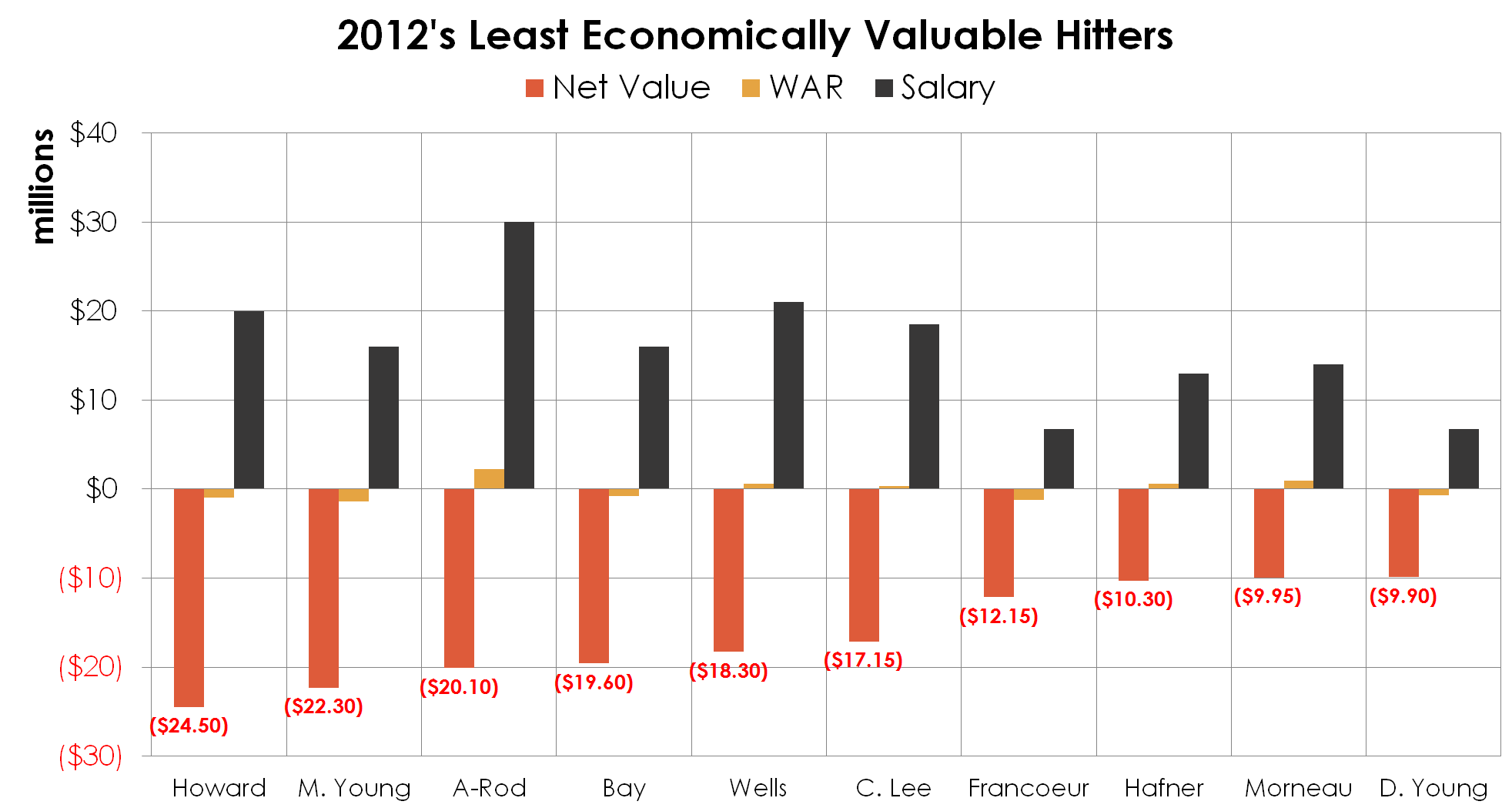
The combination of bad performance and a large salary is the least valuable contribution a player could make to his team. Thus, I have compiled a list of 2012's LVP's; enjoy.

The equation I will be using combines a player's performance, quantified by WAR (wins above replacement) with his salary. The weird thing about WAR is that it is measured differently by different people, so I will be using Fangraphs version of it (Fangraphs is a highly reputable sabermetrics site).

For more on WAR, read here.

I then turned WAR into a dollar number by combining it with $4.5 million, a fairly standard price that a team pays for one WAR. Thus, a player's net value to his team can be shown using the equation:
(WAR*$4.5 million) - Salary. 


As you can see, Ryan Howard of the Phillies was 2012's least economically valuable hitter.

As for the pitchers:

Johan Santana took the cake for the pitchers. 

A common trend, especially amongst the hitters, are the aging veterans being overpaid to underperform. Every single hitter was above age 30 during the 2012 season except for Delmon Young, who was a number one draft pick in 2003, and hasn't done anything notable since then. The reason Howard won last year's LVP was because of his poor WAR (-1) and his gigantic, $20 million salary. A-Rod actually had a positive WAR in '12, at 2.2 (which is hardly productive given his ridiculously large salary) but was paid $30 million, which dragged him all the way to number 3 on the list. 

Will teams ever stop paying aging veterans? Or stop tying up 29, 28 year old players for 7+ years and $100 million+ ? The world may never know...

Friday, May 17, 2013

The Case for Married Men

So, apparently baseball players should stop focusing on getting hits, and should instead try to get hitched.

Researchers Francesca Cornaglia and Naomie E. Feldman conducted a research report in 2011, with samples of MLB players from 1871-2007, that yielded the veeeeerrrrry interesting result that married players earn more than single ones. This gap is precisely 16% between the wages of married players and unmarried ones.

Sure, Bryce Harper's great right now, but if he doesn't get a haircut and get married, how long can he sustain this success? (I'm kidding...sort of)

Economists have for a long time documented the "marriage premium" that married men enjoy in all professions (somewhere between 10 and 40 percent) in their wages. However, they have trouble explaining this phenomenon.

Baseball players, on the other hand, have perhaps provided us an explanation.

Since baseball is so quantitatively inclined (it has its own branch of statistics, sabermetrics, after all), Cornaglia and Feldman were able to isolate variables and produce conclusions. They measured production with stats like batting average and On-base plus Slugging (OPS), sorted players by ability (low, medium, high) and age (early and late career).

They concluded that the marriage premium (a correlation between marriage status and wage) does exist. What this entails is that within each sector (young players, old players, high-ability players, low-ability players), married men are paid more.  However, they found that marriage status has weak effect on productivity for all these players. Well, if productive players are paid more, how does marriage affect earnings?

Interestingly, in high-ability players, wives are able to extract the most economic gain from their husband's situation. This is called "direct-augmentation" by Feldman and Cornaglia, who postulate that wives of high-ability players are able to maximize sponsorships and public image as opposed to single, high-ability players. Thus, marriage directly impacts their wages.

On the other hand, low-ability players who are married benefit from "indirect-augmentation," in which wives are able to take care of the players at home and allow them to focus more on the field. Thus, marriage indirectly impacts earnings through productivity.

Furthermore, on a team-level, the success of teams (number of wins) is directly correlated with the fraction of married players on the team. This is perhaps due to the fact that marriage breeds responsibility, leadership and the ability to work as a team in players, and teams with more of these type of men will succeed.


Get a ring, to get a ring.


There is much more to read about this phenomenon in Cornaglia and Feldman's research report, and if you'd like to read it, it can be found here.


The Rays: A Simple Lesson in Comparative Advantage

In my last post, I discussed the inherent flaws with Michael Lewis' Moneyball concept. In summary, rich teams can buy good players, good players win games; its that simple. However, the Tampa Bay Rays (formerly, the Devil Rays) have continuously found a way both to succeed in a division containing the Yankees and the Red Sox and to be cost-effective. In essence, the Rays contradict my aforementioned notion that cost-saving is pointless. The natural question to ask is: how do they do it?


First of all, let's take a moment to appreciate the Tampa Bay Ray's 2013 payroll: $57-million. Now, the Orioles pay $91-million, Toronto at $1.18-billion, Boston at $1.59-billion, and the Yankees pay a mind-numbing $2.29-billion. Compared to their AL East competitors' payrolls, the Rays are plebeians. (Source)

How have the Rays averaged more than 90 wins a season for the last three years? The 2013 payroll supports my previous hypothesis that those teams that pay more, win more; the Rays' payroll places them in the company of San Diego ($71-million), Oakland ($68-million), Pittsburgh ($66-million), Miami ($39-million), and Houston ($24-million). Only the Marlins and the Astros pay less than the Rays, and both of these teams are on pace together to win less than 100 times this season (both are 11-30 so far; they'd have trouble winning in the SEC). All the Rays have done is win two AL East titles in the last five years.


Someone, please explain to Cashman how the Rays do it! It's madness!

Well, according to Jonah Keri, who wrote a book on the Rays' success, "The Extra 2%: How Wall Street strategies took a Major League Baseball Team from Worst to First," the Rays could teach a college course in comparative advantage.

Summarily, the Rays look for the extra 2%, whether it be on the field or off, and after a while, all these little advantages add up and lead to wins. They build optimal lineups to expose certain pitchers, they matchup relief pitchers very smartly in order to grind away outs, but most importantly, their manager Joe Maddon meets with, and actually listens to the "quant" guys in the organization.

For example, the head of the Rays' R&D division (who are they, Google?) met with Maddon and suggested that the Rays counterintuitively start same-handed hitters against certain pitchers, like John Danks. This is called the Danks Theory, named after lefty pitcher John Danks, who's ability to throw changeups well makes him a harder matchup for righties than lefties. Well, Maddon adjusted his strategy accordingly, and likely earned 2 or 3 wins because of this.

2 or 3 wins don't seem like a lot, but if you add up a bunch of these marginal advantages, you start to become a successful baseball team. The Rays were also one of the first teams to embrace sabermetric measures for fielding ability, which also probably added a couple wins to their record. The secret behind the Rays success is not their star players, like Evan Longoria, and David Price. In fact, according to Keri, it is their ability to purchase and maximize the abilities of players like Ben Zobrist, a swiss-army knife like player who can play any position well, and James Loney, a former top prospect turned "bust" who they acquired cheaply this year and is currently batting .367.

Off the field, the Rays sell their veterans quickly (try explaining that one to the Yankees) before they're market value diminishes too much, and emphasize their farm system, where they can either use their prospects to win games, or sell them for finances.

In baseball, and especially against the Red Sox and Yankees, every edge counts. The Rays know that they cannot compete with the corporate teams in the free-agent market, since they will be outbid most of the time, so they allocate their resources to smaller markets such as their farm system. On the field, the Rays know that they cannot hit more homeruns than other teams, since homeruns command high prices, so they do the little things right, such as exploiting matchups and fielding the ball well. In the end, all of these little advantages add up.

In 2008, the Rays blindsided the Yankees, and the media.

The Rays solved the MLB. If you can't fight with the best, don't. Just give up, learn to throw sand in their eyes, and hit them in the back, or better yet, when they're not looking. Hey, winning is winning!


Wednesday, May 15, 2013

Debunking Bill James

Moneyball is wrong. Gasp.

A struggling DVD store (yes, they still exist) refuses to inject too much of their own capital into their almost-bankrupt company. The manager of the business beams with pride at their ability to not use up too much capital; patrons of the store applaud the continuing mediocrity. This is the problem with Moneyball.

Ever since Michael Lewis' book glorifying the cost-effectiveness of the Oakland Athletics hit shelves, both casual and die-hard fans alike have been either groaning at their billionaire owners willingness to dump buckets of cash on aging veterans, or jumping with joy at their decision to lock up a budding star player with a relatively cheap contract. These fans are applauding their mediocre teams for having the highest collective WAR (wins above replacement) per dollar spent. They are also condemning the big franchises like the Dodgers and the Yankees for spending so imprudently.

However, last time I checked, most of the big spenders, like the Yankees/Red Sox/Angels are still good, and the A's/Mariners/Pirates are still pretty much terrible. But, hey, they spend the least, so hurrah!


Brad Pitt/Billy Beane would like to disagree...

Unfortunately for all believers in Lewis' bible, baseball teams do not play on even economic footing. According to the Collective Bargaining Agreement, signed in 2012 and running through 2016, there is still no salary cap in baseball like there is in the NFL. MLB teams are allowed to spend as much as they want to get the talent that they want, and on the field, talent wins games, not cost-efficiency (tell that to Bill James). There is no point in reducing one's WAR per dollar spent if the big MLB franchises can just spend double on their teams.

Moneyball is appealing to fans of small-market teams, like the Pittsburgh Pirates, since the micro-economics aspects of cost-saving gives them hope for the future. In essence, there is a widespread assumption that those who spend extravagantly will eventually get what they deserve (tumult, disaster, locust-swarms, whatever).

Take Albert Pujols, for example, baseball greatest slugger of the past decade. Pujols just recently signed a 10-year, $250-million contract to hit home runs for the Los Angeles Angels. Sure, his contract would make Billy Beane, and all supporters of Moneyball-economics weep, but the Angels have Pujols hitting for them, something the A's can't say. The billionaire owners of the Angels are not going to go bankrupt, and their team is going to keep winning because not despite of their extravagant spending.


Worth $250-million? If you can stomach the cost (which most billionaire owners can), absolutely


Good players win games, and good players are expensive. Thus, the teams who are willing to shell out hundreds of millions of dollars to purchase these mercenaries will most likely be the most successful. Unlike the NFL, the need to maximize dollar efficiency does not apply to the MLB. Moneyball is an attractive concept, but is pretty much void in baseball.

The problem with baseball, which is the same with the rest of the big financial institutions in the world, is that the teams are owned by billionaires who don't spend their own money. Fans need to stop supporting cost-effectiveness and saving as long as a salary cap doesn't exist. For the MLB and Wall-street, those who spend the most, usually win.

Welcome!

Hi guys! Welcome to Baseball-nomics, a blog where I will be discussing the numbers behind the ultimate numbers' game. On the field, baseball statistics are affectionately referred to as "sabermetrics," but like any other Major League sport, baseball is not immune to the laws that govern economics. This latter aspect of the game is where this blog will be most concerned with, but some sabermetrics may be thrown in to illustrate some points...

 My goal is get you to love baseball as much as I do, but not just as a game---as a captivating enclosed financial market between 32 teams!


  Some food for thought: are the free-spending, wheeling and dealing Yankees ever going to get their just desserts?